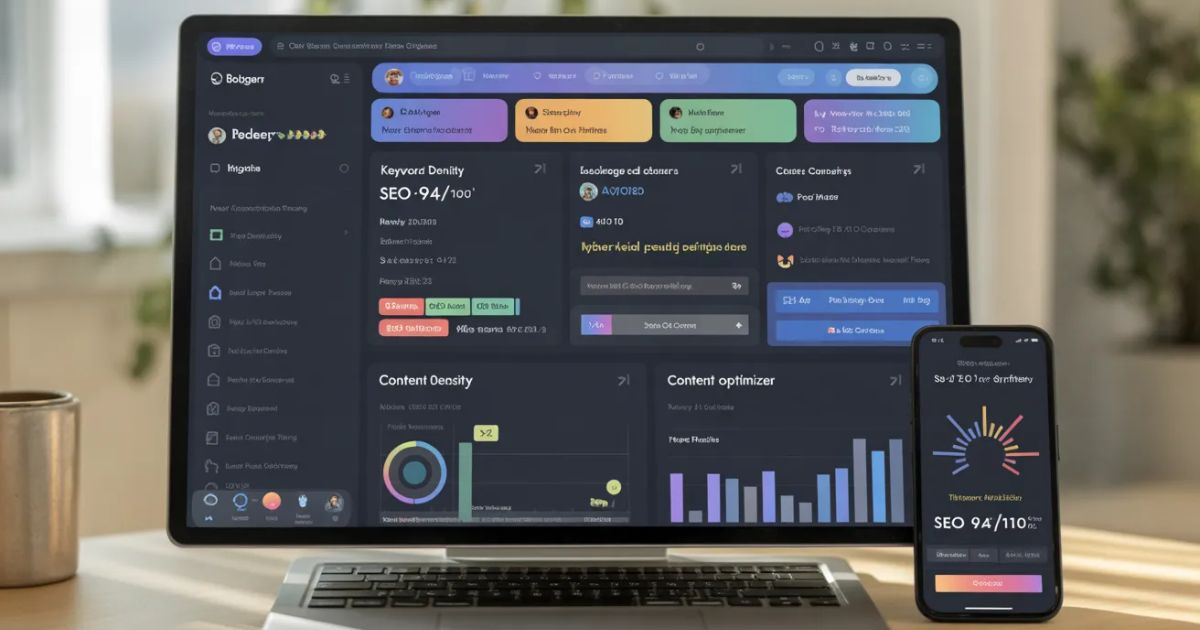
ai seo tools for bloggers
In 2026, the blogging landscape has undergone a seismic shift from traditional “link-and-click” results to a conversational, answer-driven ecosystem. With Google’s AI Overviews and platforms like ChatGPT, Claude, and Perplexity effectively becoming the web’s front door, the competition for visibility has never been more intense. Bloggers no longer just compete for the top of Page 1; they are fighting to become the cited source that powers the AI’s response. To survive this “Zero-Click” era, mastering ai seo tools for bloggers is no longer a luxury—it is the foundational requirement for digital relevance.
The traditional workflow of manually hunting for keywords and guessing search intent is officially obsolete. Modern ai seo tools for bloggers now act as sophisticated intelligence hubs, utilizing advanced Natural Language Processing (NLP) to map out topical clusters, predict emerging search trends before they peak, and ensure every paragraph adheres to strict EEAT (Experience, Expertise, Authoritativeness, and Trustworthiness) standards. These tools allow solo creators and small teams to produce content that is “mathematically” optimized for answer engines while maintaining the authentic, human-centric voice that readers—and algorithms—now demand. Whether you are aiming to dominate niche search queries or secure your place in a generative summary, this guide will show you how to leverage 2026’s most powerful AI technology to turn search disruption into your greatest growth engine.

Why AI SEO Tools are Essential in 2026
The gap between “content” and “authority” has widened. As AI-generated noise saturates the web, search engines have pivoted to rewarding Information Gain—the inclusion of unique facts, data, or experiences not found elsewhere. AI seo tools for bloggers help you identify these gaps in the market, ensuring your blog doesn’t just repeat what is already there but provides the missing piece of the puzzle that search engines are desperate to index.
- Predictive Trend Sensing: Move from reactive blogging to proactive leadership by identifying questions users will ask next week.
- Semantic Entity Optimization: Automatically include the technical concepts and related terms (entities) that prove to Google you are a true subject matter expert.
- AEO Readiness: Format your content perfectly for “Answer Engine Optimization,” making it easy for LLMs to extract and cite your work.
1. Why AI SEO Tools are Essential in 2026
Search has evolved into a “dialogue.” In 2026, Google doesn’t just match words; it understands intent and entities. If you aren’t using AI to analyze these connections, you are essentially blogging in the dark.
AI SEO tools provide three critical advantages:
- Predictive Analytics: They identify trending topics weeks before they appear in traditional keyword tools.
- Semantic Mapping: They ensure your content covers every subtopic Google expects for a “complete” answer.
- Answer Engine Optimization (AEO): They help structure your content so it gets cited as a source in AI-generated search summaries.
2. Top AI SEO Tools for Bloggers in 2026
Based on performance, accuracy, and Google EEAT compliance, these are the standout tools this year.
Surfer SEO (Best for Content Optimization)
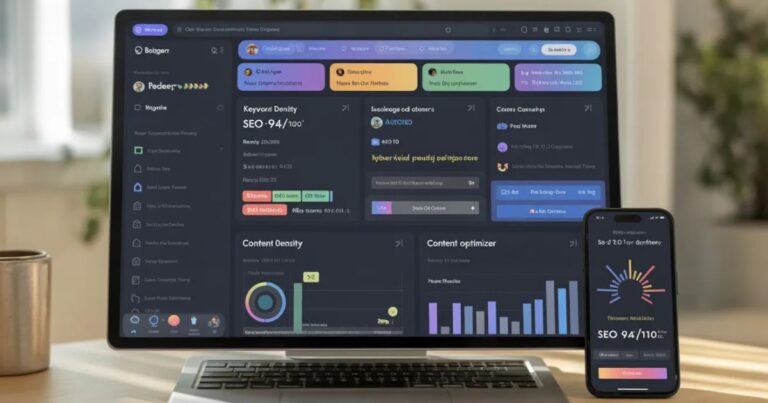
Surfer remains the gold standard for on-page SEO. In 2026, its “Auto-Optimize” feature uses live SERP data to suggest exactly which semantic terms will push your post to the top.
- Key Feature: The NLP Content Score which measures how well you’ve covered a topic compared to top-ranking competitors.
- Best For: Intermediate bloggers who want a scientific approach to ranking.
RankIQ (Best for Niche Bloggers)
RankIQ is designed for solo creators. It features a hand-picked library of low-competition keywords specifically for niches like food, travel, and DIY.
- Key Feature: The AI SEO Report tells you exactly what to put in your title and which questions to answer.
- Best For: Beginners who want to avoid complex technical data.
MarketMuse (Best for Topical Authority)
If you want to be the “go-to” expert in your field, MarketMuse is the tool. It analyzes your entire site to find “content gaps”—topics you haven’t covered that are hurting your authority.
- Key Feature: Topical Clusters that show you how to link your posts to build a “knowledge graph.”
- Best For: Serious bloggers looking to build long-term brand power.
LLMrefs (Best for AI Search Visibility)
A newcomer in 2026, this tool specifically tracks how often your blog is cited in ChatGPT, Claude, and Google AI Overviews.
- Key Feature: Generative Engine Optimization (GEO) Tracking.
- Best For: Bloggers aiming for “Zero-Click” search dominance.
3. The 2026 AI SEO Workflow: A Step-by-Step Guide
To rank in 2026, you must use AI as a strategist, not a ghostwriter. Follow this workflow:
Step 1: Intent Discovery
Use a tool like Frase to analyze the “micro-intent” of a query. Is the user looking for a quick tip or a deep-dive case study? Structure your post to match that specific intent immediately.
Step 2: Semantic Outlining
Generate an outline that includes “Entities.” For example, if you’re writing about sustainable gardening, your AI tool should remind you to include composting, native species, and soil microbiome.
Step 3: The “Human Plus” Draft
Write your content. Use AI to expand on technical definitions or generate bullet points, but manually inject your own experience. Google’s 2026 algorithm prioritizes “Experience” (the first ‘E’ in EEAT). Mention personal stories, failures, and unique results.
Step 4: Answer-First Formatting
Ensure your H2 and H3 headings are framed as questions. Provide a direct, 2-3 sentence answer immediately following the heading. This makes your content “extractable” for AI Overviews.
4. How to Use AI Safely (Without Getting Penalized)
Google’s “Helpful Content” systems in 2026 are highly sensitive to mass-produced, low-effort AI text.
- Avoid “Commodity” Content: If your post says the exact same thing as the top 10 results, it won’t rank. Add a unique perspective or original data.
- Fact-Check Everything: AI tools still “hallucinate.” A single factual error can tank your Trustworthiness score.
- Edit for Tone: AI often uses repetitive, flowery language. Use a tool like QuillBot or manual editing to ensure your voice sounds natural and direct.
- Check for Over-Optimization: Don’t force keywords where they don’t fit. If a sentence sounds robotic to you, it will look like spam to Google.
5. The Future of Blogging and AI
We are moving toward a “Verified Web.” In the future, your personal brand and author reputation will be as important as your content. Successful bloggers in 2026 will use AI to handle the data-heavy lifting while they focus on building a community and providing real, human-tested advice.
6. Frequently Asked Questions (FAQs)
1. How to use AI to write SEO blogs?
AI helps with keyword research, content outlines, drafting, optimization, and FAQs. The best results come when AI is used for speed and structure, while humans add originality, experience, and accuracy before publishing.
2. Which SEO tool is best for blogging?
There is no single best tool. Bloggers usually get the best results by combining:
- Surfer SEO for on-page optimization
- RankIQ for low-competition keywords
- Google Search Console for performance tracking
3. Which AI is best for blogging?
ChatGPT and Gemini are the most effective AI tools for blogging in 2026. They support topic research, structured writing, FAQs, and SEO optimization when combined with human editing.
4. Can ChatGPT do SEO?
Yes. ChatGPT can assist with keyword ideas, content structure, meta descriptions, internal linking, and FAQs. However, it should support SEO strategy—not replace it completely.
5. What is the 30% rule in AI?
The 30% rule means at least 30% of AI-generated content should be improved by a human. This includes adding unique insights, examples, updated facts, and personal experience to meet Google quality standards.
6. Can I do SEO with AI?
Yes. AI can automate research and optimization tasks, but human judgment is still required for strategy, accuracy, and content quality.
7. What are the 4 types of SEO?
- On-page SEO – content, keywords, headings
- Off-page SEO – backlinks and authority
- Technical SEO – site speed and indexing
- Local SEO – location-based optimization
8. Which are the top 5 AI tools?
The top ai seo tools for bloggers are:
- ChatGPT
- Gemini AI
- Jasper AI
- Surfer SEO
- Frase

9. Can I learn SEO in 3 months?
Yes. In three months, you can learn SEO fundamentals like keyword research, on-page optimization, and content strategy. Advanced SEO improves with practice and real projects.
10. How to get 1000 views per day on a blog?
Focus on low-competition keywords, publish helpful content consistently, build internal links, update old posts, and promote content through search and social platforms.
11. What is the 80/20 rule in blogging?
The 80/20 rule means 20% of your content usually drives 80% of your traffic. Smart bloggers focus on optimizing high-performing posts instead of publishing random content.
12. Does Google accept AI-written blogs?
Yes. Google accepts AI-written content if it is helpful, original, accurate, and written for users—not just for rankings.
13. Does Google penalize AI content in 2026?
No. Google rewards quality, not how the content is produced. However, it penalizes scaled content abuse, where large volumes of low-value AI content are published only to manipulate rankings.
14. What is the most important SEO factor in 2026?
Helpfulness is the most important factor. Content that fully answers user questions with accuracy, clarity, and real experience (EEAT) consistently ranks higher.
15. Can I use ChatGPT to write my entire blog?
You can, but it is risky. Pure AI content often lacks information gain—new or unique insights. Editing and adding personal expertise greatly improves ranking potential.

16. How do I get my blog featured in AI Overviews?
Use clear H2 and H3 headings, add FAQ or How-To schema, and place direct, concise answers early in the content. Well-structured and trustworthy content has a higher chance of appearing in AI Overviews.
17. Are free AI SEO tools worth it?
Yes, for basic data and monitoring. Tools like Google Search Console are essential. However, paid AI SEO tools provide deeper competitor analysis and NLP optimization needed to compete in competitive niches.
About the Author


Welcome to Techoway – Your Trusted Technology Hub
At Techoway, we provide reliable insights into the world of technology. From the latest tech news and in-depth product reviews to practical how-to guides and simplified explanations of complex topics, our mission is to keep you informed, empowered, and inspired.
We are committed to making technology accessible and easy to understand for everyone, because the future belongs to those who embrace innovation with confidence.