"AI tools for students in 2026"
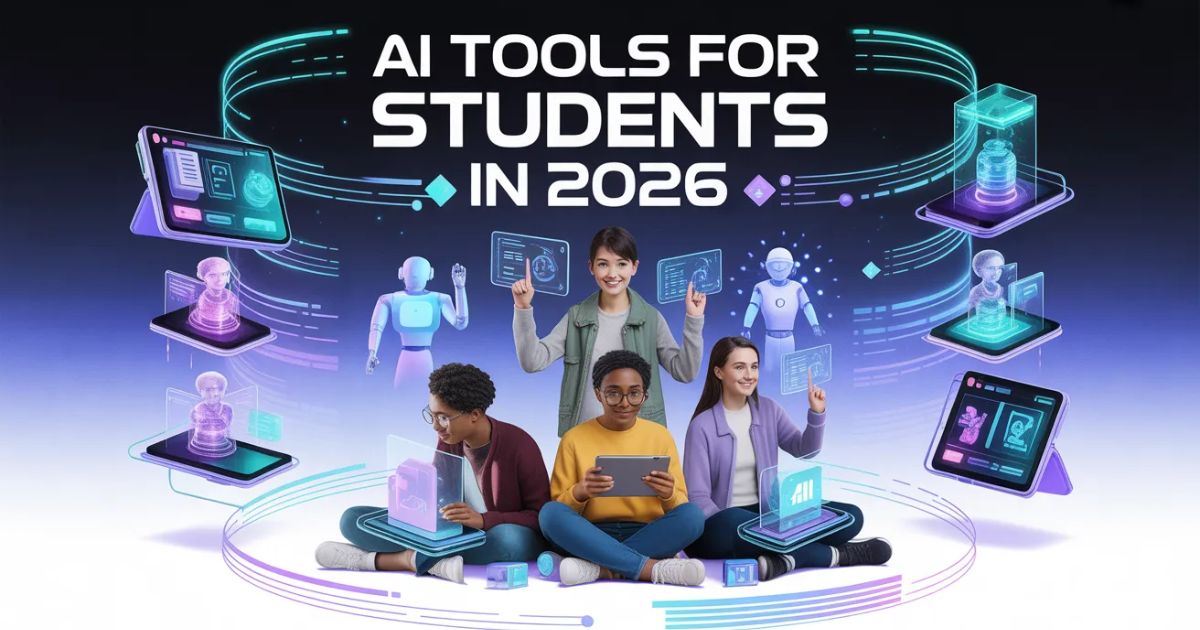
In 2026, the academic world has shifted from a “search-and-find” model to a “synthesis-and-apply” landscape. Students no longer spend hours sifting through irrelevant search results; instead, they utilize advanced, integrated systems that function as 24/7 personal mentors. Mastering AI tools for students in 2026 has become the primary differentiator between those who simply complete assignments and those who achieve true subject mastery.
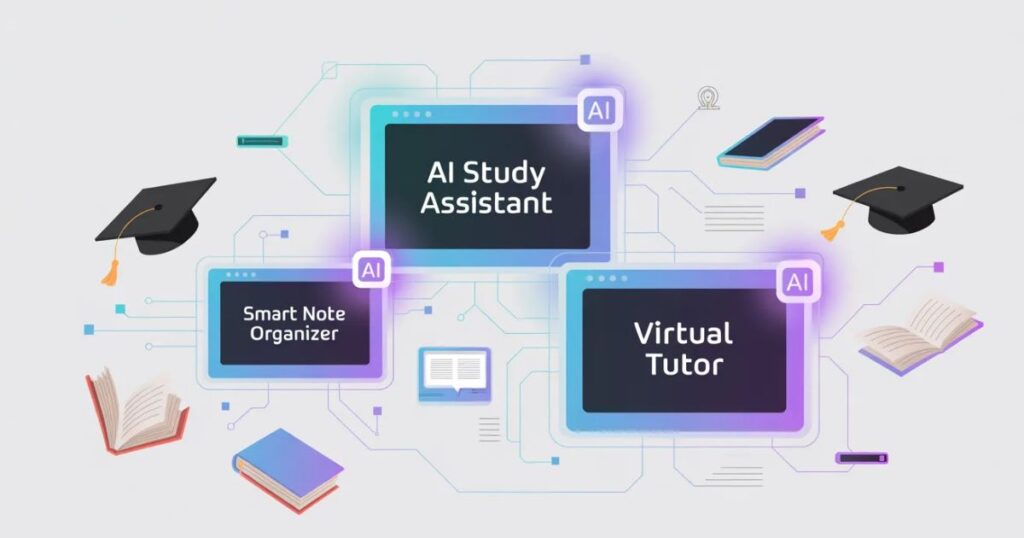
The modern student toolkit is no longer just about generating text. It is a sophisticated ecosystem of specialized agents designed to handle everything from real-time lecture transcription to predictive study scheduling. By leveraging these technologies, learners can offload repetitive administrative tasks—such as bibliography formatting or note organization—to focus entirely on critical thinking and complex problem-solving.
Key Pillars of the 2026 Academic AI Ecosystem
- Hyper-Personalized Learning Paths: AI now analyzes individual performance data to create custom study plans that adapt in real-time to a student’s strengths and weaknesses.
- Generative Engine Optimization (GEO): Students use AI to ensure their research papers are structured for “discoverability” by the latest answer engines and academic LLMs.
- The “Human-AI” Hybrid Workflow: Top students adopt a “sandwich” approach: Human Ideation → AI Data Mining → Human Analysis → AI Polishing.
- Predictive Success Analytics: New tools identify “knowledge gaps” before an exam occurs, nudging students to review specific concepts during peak focus hours.
This evolution ensures that AI tools for students in 2026 serve as a cognitive ladder, helping every learner reach higher levels of academic excellence regardless of their starting point.
The academic environment in 2026 demands more than just traditional study habits. As search engines evolve into comprehensive answer engines, artificial intelligence (AI) has become a primary driver of student efficiency. Today, AI tools for students in 2026 function as personalized cognitive partners, helping learners synthesize vast amounts of data into actionable knowledge. This guide delivers a direct, actionable breakdown of the technology you need to stay competitive.
Why AI Tools Define Student Success in 2026
Artificial intelligence bridges the gap between raw information and deep understanding. Students now use these tools to automate low-value tasks, allowing more time for critical analysis and creative problem-solving.
- Personalized Pace: AI adapts to your learning speed, providing extra drills for difficult concepts.
- Information Synthesis: Tools summarize thousands of pages of research in seconds.
- Global Accessibility: Real-time translation and transcription break down language and physical barriers.
- 24/7 Tutoring: Instant, high-quality explanations for any subject at any time.

Top AI Tools for Students in 2026
The following tools represent the current gold standard for academic productivity and research excellence.
1. Research and Discovery
- Perplexity AI: This tool functions as a citation-backed research engine. It provides direct answers with clickable links to academic sources, ensuring you never rely on unverified claims.
- NotebookLM (Google): Ground your research in your specific sources. Upload up to 50 PDFs or notes, and the AI will answer questions strictly based on those documents.
- Consensus: An AI search engine that extracts findings directly from peer-reviewed scientific research. It is essential for evidence-based arguments.
2. Writing and Language Mastery
- Grammarly (2026 Edition): Far beyond spell-check, Grammarly now acts as a writing mentor. It helps you strengthen your thesis statement and ensures your tone meets professional academic standards.
- QuillBot: The premier tool for paraphrasing and summarizing. Use it to refine your prose and simplify dense academic jargon.
- Paperpal: Specifically designed for researchers, this tool polishes manuscripts to meet journal-level standards, focusing on technical precision.
3. STEM and Technical Problem Solving
- Wolfram Alpha: This computational engine solves complex equations in calculus, physics, and chemistry using symbolic logic. It provides step-by-step reasoning rather than just the final answer.
- ChatGPT (o-Series Models): These models use “Chain of Thought” reasoning to break down advanced logic and coding problems into verifiable steps.
4. Organization and Productivity
- Notion AI: A unified workspace that converts messy lecture notes into structured study guides, project timelines, and databases.
- Otter.ai: This tool records and transcribes lectures in real-time, highlighting key terms and creating searchable summaries.
How to Use AI Effectively in Your Academic Workflow
To maximize the benefit of AI tools for students in 2026, adopt a “Verify and Refine” approach.
- Phase 1: Deep Research: Use Perplexity to identify the primary arguments of your topic and secure reputable sources.
- Phase 2: Source Grounding: Upload your collected PDFs to NotebookLM to find connections between different studies without leaving the document.
- Phase 3: Human Drafting: Draft your assignment manually. Your unique voice and personal insights provide the “Experience” that AI cannot replicate.
- Phase 4: Optimization: Use Grammarly or QuillBot to improve clarity and flow.
- Phase 5: Integrity Check: Run your final draft through a plagiarism and AI-detection suite to ensure your work remains original.
Safe and Ethical AI Practices
Academic integrity is non-negotiable. Follow these rules to use AI without compromising your reputation:
- Cite the Usage: Many institutions now require an “AI Disclosure Statement” explaining how you used technology during the project.
- Verify Facts: AI can generate “hallucinations.” Always cross-reference AI-generated statistics with the original source.
- Protect Privacy: Do not upload unpublished research or sensitive personal data into public AI models.
- Focus on Learning: Use AI to explain the how and why. If you only use it to generate the what, you bypass the learning process.
Future Trends of AI in Education
As we look past 2026, educational technology will move toward Immersive Learning. Expect to see AI tutors integrated into Virtual Reality (VR) environments, allowing students to conduct virtual lab experiments or walk through historical recreations. Furthermore, AI will likely become more “proactive,” suggesting study sessions based on your biometric focus levels and upcoming deadlines.
Frequently Asked Questions (FAQs) – AI Tools for Students in 2026
1. How can AI help students learn faster?
AI eliminates the time spent searching for information. By providing instant summaries, tailored explanations, and study aids, students can focus directly on applying knowledge effectively.
2. Are AI tools reliable for assignments?
AI is reliable for brainstorming, outlining, and formatting. However, students must verify factual accuracy and ensure outputs align with assignment guidelines. Human oversight is essential.
3. Can AI replace traditional learning methods?
No. AI enhances learning but does not replace critical thinking, mentorship from teachers, or the collaborative benefits of classroom discussion.
4. Does Google allow AI-generated academic content?
Google rewards high-quality, helpful content regardless of production method. Universities, however, often prohibit submitting unedited AI text as your own work.
5. Which AI tools are best for collaborative learning?
Notion AI and Canva for Education excel in collaboration, enabling multiple students to brainstorm, design, and organize projects in a shared, AI-powered environment.
6. How do students avoid plagiarism when using AI?
Always rewrite AI-generated suggestions in your own words. Use AI for structure, research synthesis, or idea generation, not as the final submitted text.
7. Is there a free AI for math?
Photomath and the free tier of Wolfram Alpha provide step-by-step help for most high school and undergraduate math problems, making learning interactive and visual.
8. Can AI help with exam anxiety?
Yes. Tools like Quizlet AI generate practice tests and flashcards based on your notes, allowing active recall and building confidence before exams.
9. What is the best AI for research papers?
- Perplexity AI and Consensus are excellent for locating peer-reviewed evidence.
- Jenni AI is specialized in academic writing structure, helping with thesis, paragraphs, and citations.
10. Do I need to learn prompt engineering?
By 2026, most AI models understand natural language exceptionally well. Focus on clear, specific instructions rather than complex prompt “hacks.”
11. How to use AI to write SEO blogs?
AI can assist with keyword research, content outlines, drafting, and optimization. Best results come when humans add originality, insights, and verified information.
12. Which SEO tool is best for blogging?
A combination works best:
- Surfer SEO – on-page optimization
- RankIQ – niche low-competition keywords
- Google Search Console – monitoring performance

13. Which AI is best for blogging?
ChatGPT, Gemini AI, and Jasper AI are top choices. They support research, structured writing, SEO optimization, and FAQ generation, especially when combined with human editing.
14. Can ChatGPT do SEO?
Yes, it can assist with keyword ideas, meta descriptions, internal linking, and content structure. It should supplement, not replace, an SEO strategy.
15. What is the 30% rule in AI?
At least 30% of AI-generated content should be revised or enhanced by humans with personal insights, examples, and verified data to meet Google’s EEAT standards.
16. Can I do SEO with AI?
Yes, AI can automate research and content optimization, but human oversight is still required for accuracy, strategy, and readability.
17. What are the 4 types of SEO?
- On-page SEO – content, headings, keywords
- Off-page SEO – backlinks, authority
- Technical SEO – speed, indexing, site structure
- Local SEO – location-based optimization
18. Which are the top 5 AI tools?
- ChatGPT
- Gemini AI
- Jasper AI
- Surfer SEO
- Frase
19. Can I learn SEO in 3 months?
Yes. Basics like keyword research, on-page optimization, and content strategy can be learned in 3 months. Advanced SEO takes longer and improves with practice.
20. How to get 1000 views per day on a blog?
Use low-competition keywords, publish helpful content consistently, build internal links, update old posts, and promote content via social media.
21. What is the 80/20 rule in blogging?
20% of content often drives 80% of traffic. Focus on improving and promoting high-performing posts instead of creating random content.
22. Does Google accept AI-written blogs?
Yes, if content is helpful, original, and high-quality. Google penalizes low-effort or spammy content, not AI itself.
23. Does Google penalize AI content in 2026?
No. Google rewards quality content regardless of AI usage but penalizes scaled content abuse—publishing hundreds of low-value pages to manipulate rankings.
24. What is the most important SEO factor in 2026?
Helpfulness. Content that fully answers user queries with accuracy, clarity, and personal experience (EEAT) ranks highest.
25. Can I use ChatGPT to write my entire blog?
You can, but pure AI content often lacks information gain. Always edit and add unique insights to boost rankings.
26. How do I get my blog featured in AI Overviews?
Use H2/H3 question headings, add FAQ or How-To schema, and provide concise, direct answers early in the content. Well-structured content is more likely to be cited.
27. Are free AI SEO tools worth it?
Yes, for basic research and monitoring. Tools like Google Search Console are essential, but paid AI tools provide competitor analysis, NLP suggestions, and deeper optimization.
About the Author


Welcome to Techoway – Your Trusted Technology Hub
At Techoway, we provide reliable insights into the world of technology. From the latest tech news and in-depth product reviews to practical how-to guides and simplified explanations of complex topics, our mission is to keep you informed, empowered, and inspired.
We are committed to making technology accessible and easy to understand for everyone, because the future belongs to those who embrace innovation with confidence.